
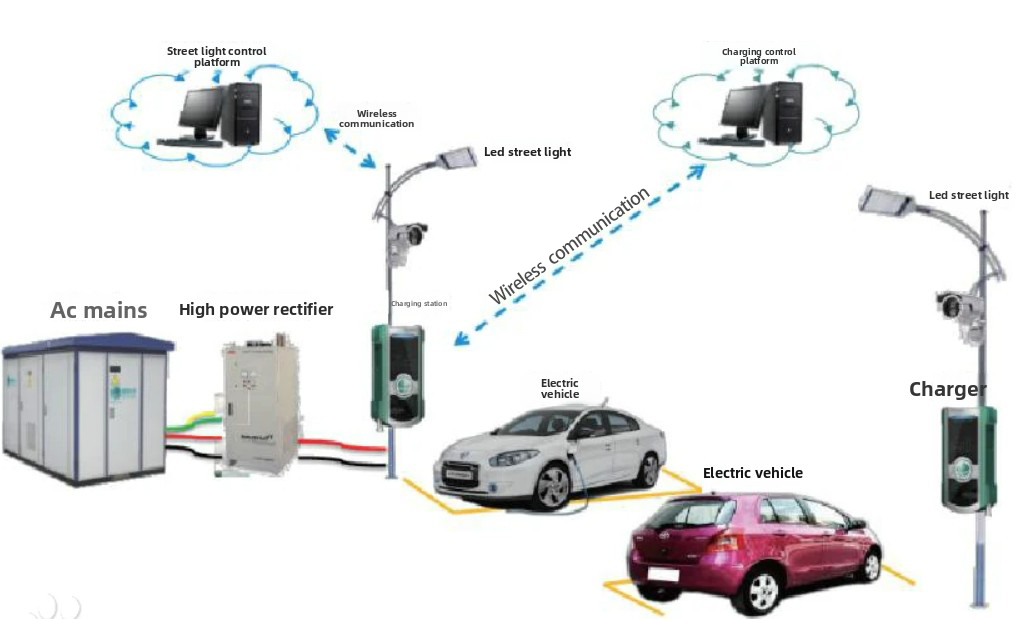
Smart streetlight ev charging stations are electric vehicle charging facilities integrated into streetlight poles. By converting traditional streetlights into LED lights to release electrical capacity, they integrate road lighting and charging functions. Their core advantages lie in utilizing existing urban streetlight infrastructure, reducing construction costs, increasing charging network coverage density, and supporting complementary power supply from solar and grid power, as well as intelligent management.
Technical principles and core functions
The smart street light charging station saves circuit capacity by converting high-pressure sodium lamps to LED lights, eliminating the need for additional land or power lines. The core technology includes:
1. Dual Power Supply System: During the day, solar panels convert and store electrical energy; at night, battery power is prioritized. When the battery is low, it automatically switches to mains power. Some designs integrate wind power to achieve “wind-solar-storage-charging integration.”
2. Intelligent Control Module: Equipped with energy metering, an S3C2410 main control chip, and NFC/RFID communication technology, supporting remote reservation, payment, and charging status monitoring via mobile app.
3. Safety Protection Design: Integrates lightning rods, anti-theft fasteners, temperature and humidity control modules, and leakage protection circuits. Some patented designs feature a telescopic ev charging gun storage and automatic cable retraction structure.
Application Cases and Promotion Progress
1. Domestic Pilot Projects: In 2015, the first batch of 84 streetlights in Changping District, Beijing, were upgraded, connecting 10 charging piles. By 2025, charging piles including 2 DC fast charging stations (single pile power ≥7kW) and 8 slow charging stations will be deployed on the eastern section of Jingmi North Road. Smart streetlight ev charging piles have been promoted in Baotou and Hohhot, Inner Mongolia, with Hohhot planning to add 7,000 charging piles by 2025.
2. International Practice: Pennsylvania State University piloted the upgrade of 23 streetlights in Kansas City, Missouri, utilizing the existing power grid to reduce installation costs, achieving charging speeds more than 30% faster than commercial ev charging stations.
Social benefits and development trends
Smart streetlight charging stations integrate streetlight resources, reducing the need for grid expansion and lowering construction costs to 1/3 to 1/2 of traditional commercial charging stations. Their promotion aligns with national new energy policies, such as the 2012 “12th Five-Year Plan for Electric Vehicle Technology Development,” which supports charging network construction. Future technologies will focus on:
1. Power Boost: Some companies have launched 120kW dc fast charging piles, combining them with energy storage technology to achieve grid load balancing.
2. Smart City Integration: Linking with transportation systems and intelligent parking platforms to expand functions such as environmental monitoring and drone landing pads.
Post time: Dec-17-2025


