
Top 10 7kW Wall Mounted EV Chargers for Global Buyers
A 7kW wall-mounted charger can turn an ordinary parking space into a practical overnight charging point. Yet choosing one involves more than comparing power ratings. Cable reach, connector options, weather protection, app controls, and installation details all shape daily use. A neat unit on a product page may feel different beside a narrow garage wall, in winter rain, or during a late return home.
This guide compares ten 7kW Wall-Mounted Charging Pile options for buyers across different markets. It focuses on clear specifications and useful ownership details, while recognizing that product availability and installation needs vary by region. Look closely at rated output, safety features, warranty terms, and support access. A long cable can help. A confusing setup screen can quickly undo that benefit. Small details matter.
Dr. Kai-Philipp Kairies is an energy-systems researcher whose work is relevant to the wider electrification discussion. However, no verified quotation from him about 7kW wall chargers was provided, so this introduction does not invent one. That restraint matters. A buyer deserves evidence, not a polished sentence presented as fact. Use the comparisons as a starting point, then confirm current specifications with each manufacturer and a qualified installer. No single model suits every home.
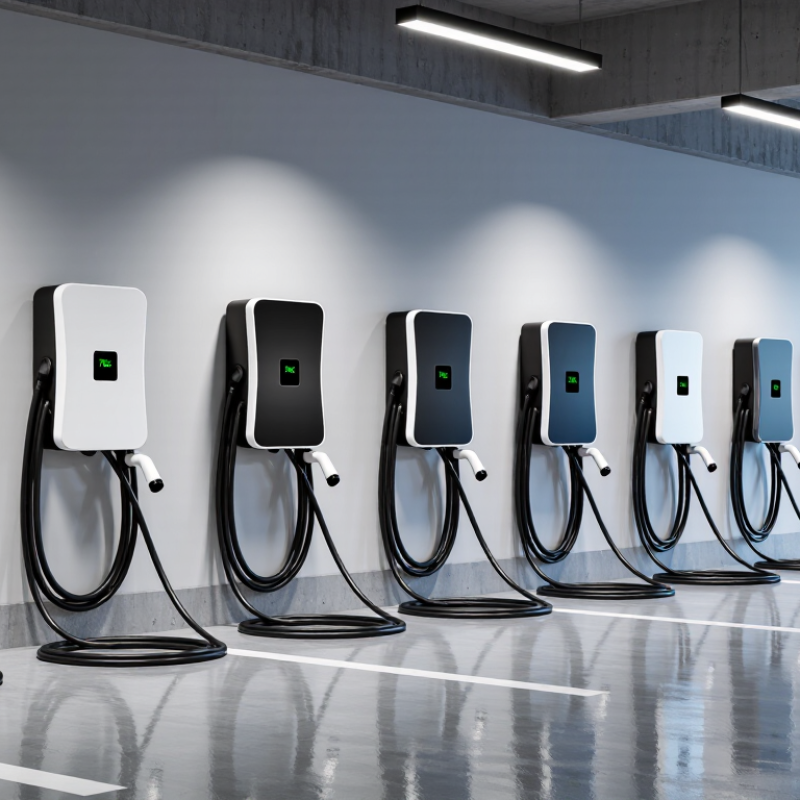
How 7kW Wall-Mounted EV Chargers Work
A 7kW wall-mounted EV charger supplies alternating current to a vehicle through a charging cable. The car’s onboard charger converts that power into direct current for its battery. The wall unit does not usually control the battery’s internal charging process; it communicates with the car and allows power to flow when conditions are suitable.
A small control signal helps the charger and vehicle agree on the available current. The system checks the connection before switching its power contacts on. If the cable is loose or a fault is detected, charging may stop. That pause is intentional. The charger also monitors electrical conditions, while proper grounding and a suitable circuit are essential parts of a safe installation.
The number matters, but it can mislead. 7kW is a ceiling, not a promise. Actual charging speed can be lower if the vehicle accepts less AC power, the supply is limited, or other loads share the circuit. For example, a car parked overnight may gain useful range without ever drawing the full rated output. Owners should check their vehicle’s charging limit and have the installation assessed by a qualified electrician. Even then, real charging times vary. That is worth remembering.
| No. | Specification or feature | Typical 7 kW wallbox reference | How it works / buyer consideration |
|---|---|---|---|
| 1 | Rated charging output | Approximately 7 kW AC | The wallbox supplies AC power; the vehicle’s onboard charger converts it to DC for the battery. Actual charging power may be lower if the vehicle or installation has a lower limit. |
| 2 | Electrical supply | Usually single-phase, around 220–240 V | Supply voltage and permitted installation arrangements vary by country. A qualified electrician should confirm the local circuit and supply capacity. |
| 3 | Charging current | Commonly up to 32 A | At 230 V, 32 A corresponds to about 7.36 kW before losses. A 7 kW label is a nominal rating; output depends on voltage and the unit’s current setting. |
| 4 | AC charging mode | Typically Mode 3 equipment under IEC 61851 | The charger and vehicle communicate before power is supplied. The wallbox provides control and safety functions, while the vehicle manages battery charging. |
| 5 | Vehicle connector | Type 2 is common in many markets; Type 1 may be used in some markets | Connector availability depends on the vehicle and region. Confirm that the wallbox connector or socket matches the vehicle or charging cable. |
| 6 | Charging duration | Depends on usable battery capacity and vehicle limits | A simplified estimate is energy added (kWh) divided by charging power (kW). For example, adding 35 kWh at a steady 7 kW would take about 5 hours, excluding losses and charging-rate variation. |
| 7 | Protection and electrical safety | Protection features vary by model and local installation rules | Check the required residual-current protection, overcurrent protection, earthing arrangement, and any built-in DC fault detection. Requirements differ by jurisdiction and equipment design. |
| 8 | Load management | Optional on many installations | Dynamic load management can adjust charging current in response to household or building demand, helping keep total load within a configured limit. |
| 9 | Enclosure and installation location | Indoor or outdoor suitability depends on the stated IP rating and installation instructions | Check the manufacturer’s enclosure rating, temperature range, mounting requirements, and exposure limits. An IP rating alone does not confirm suitability for every outdoor condition. |
| 10 | Controls and connectivity | May include basic start/stop controls, scheduling, app access, or network features | Functions are model-dependent. Confirm Wi-Fi or cellular requirements, smart-charging compatibility, and whether scheduled charging works without an internet connection. |
| Important: These are general, brand-neutral reference values, not specifications for ten individual products or a ranked product list. Always check the exact unit documentation, vehicle compatibility, local electrical regulations, and installation requirements. | |||
Related Posts
-
How to Choose the Right Electric Car Charging Pile for Your Needs?
-
Top 10 Smart Charging Piles for Global Buyers in 2026?
-
2026 How to Choose the Best EV Charger for Your Needs?
-
Top 10 Charging Station Companies You Should Know?
-
2026 Best Charging Pile Industry Innovations and Trends to Watch?
-

Why is the Charging Pile Industry Booming Worldwide?
-

Phone
-

E-mail
-

Whatsapp
-

Top